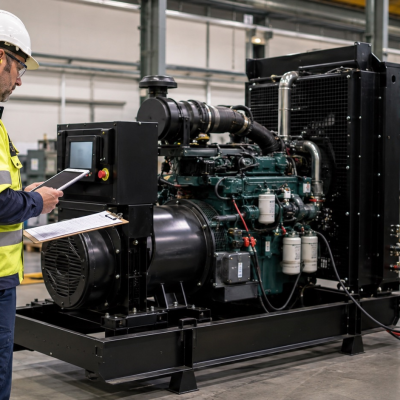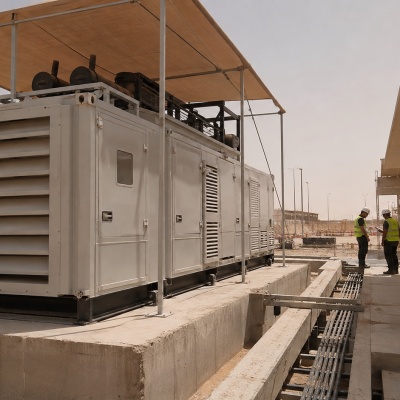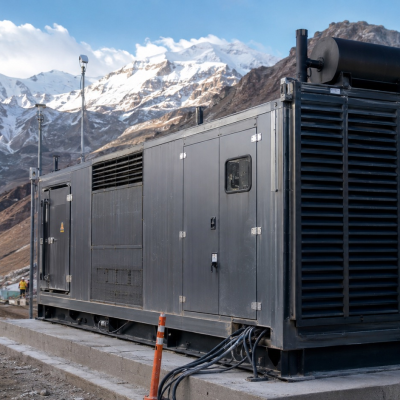


Customers often ask one question first: How many kVA do I need? The answer is not simply the total kW on an equipment list. A reliable selection must reflect operating duty, the largest load step, power factor, motor starting, site conditions and the amount of redundancy the project requires.
Start with the generator duty
Define how the set will be used before discussing size. Standby power covers utility outages. Prime power supports a variable load for extended periods where utility power is unavailable or unreliable. Continuous applications have different load assumptions again. The engine and alternator rating offered must match the required duty; the same machine can have different published ratings under different definitions.
Build a realistic load list
List every load that may operate from the generator and record its running kW, power factor, phase, starting method and expected start sequence. Separate essential loads from loads that can wait or be shed. The goal is to model what will run at the same time, not to add every connected item regardless of operating pattern.
| Information | Why it matters | Typical source |
| Running kW | Defines real power required after start-up | Nameplate, single-line diagram or measured data |
| Power factor | Converts kW to kVA and affects alternator current | Equipment data or electrical study |
| Starting current | Determines short-duration voltage and frequency dip | Motor or compressor data sheet |
| Starting method | DOL, star-delta, soft starter and VFD impose different transients | Motor control schematic |
| Load sequence | Several loads do not always start at once | Operating procedure or PLC logic |
| Non-linear load share | UPS, drives and rectifiers can affect waveform and alternator selection | Equipment supplier or harmonic study |
Understand kW and kVA
kW is real power used to perform work. kVA is apparent power and includes the effect of power factor. The basic relationship is kVA = kW divided by power factor. For example, 320 kW at 0.8 power factor equals 400 kVA. However, this is only a steady-state conversion; it does not prove that a 400 kVA set can start the largest motor or meet the required transient limit.
Check the largest load step
A 75 kW motor may draw several times its normal current when started direct on line. The generator can experience a voltage dip from alternator excitation limits and a frequency dip as the engine accepts the sudden torque demand. The actual result depends on the motor code, starter, existing base load, engine response, alternator design and the client’s permitted dip and recovery time.
If the transient is too severe, the options are not limited to buying a much larger generator. The project may use staged starting, a soft starter, a correctly configured VFD, temporary load shedding or parallel sets. The best solution compares equipment cost, process risk and operating efficiency.
Apply site derating
Generator ratings are stated at defined reference conditions. High altitude reduces air density; high temperature reduces cooling margin; severe humidity, dust or restricted ventilation may also influence the package design. Ask the supplier to show the engine and alternator derating basis and state the available site output. Do not apply one universal percentage to every engine model.
Choose the right operating margin
Some reserve is useful for uncertain loads, ageing and planned expansion, but more is not always better. A heavily oversized diesel generator may spend long periods at light load, which can increase fuel cost per useful kWh and contribute to deposits or wet stacking on certain engines. The margin should be linked to a documented expansion plan and a realistic minimum-load profile.
Decide between one set and parallel sets
One generator is simpler and usually costs less initially. Parallel sets can offer redundancy, easier maintenance and better matching between running capacity and changing demand. They also add switchgear, controls, commissioning work and protection coordination. For critical facilities, compare the consequence of a single failure with the lifecycle cost of N+1 capacity.
Confirm the electrical and mechanical details
- Voltage, frequency, number of phases and neutral arrangement.
- Standby, prime or continuous duty and expected annual running hours.
- Maximum and minimum ambient temperature, altitude, humidity, dust and corrosion exposure.
- Open, weatherproof, sound-attenuated, trailer or container configuration.
- Required fuel autonomy, tank location and refuelling method.
- ATS, synchronising, remote start, remote monitoring and communication protocol.
- Applicable emissions, noise, testing, certification and documentation requirements.
Generator sizing enquiry checklist
- Send a load schedule showing running kW, power factor and starting data for the largest motors.
- State which loads must operate together and which loads may be delayed or shed.
- Confirm site voltage, frequency, phase, altitude and maximum ambient temperature.
- Define duty, required autonomy, noise target, emissions requirement and redundancy level.
- Ask for the proposed site-rated output, transient assumptions and included test scope in writing.
The right generator is the right system match
A good selection balances steady load, transient response, environmental derating, future growth, maintenance and total operating cost. Send Everyseek your load list and site conditions. Our team can review the application and recommend a generator configuration for technical discussion before quotation.
Publication check
Before posting, confirm that product options, rating definitions, standards, warranty terms and contact links match the final Everyseek offer for the target market.
- Confirm the exact rating terminology used in Everyseek quotations.
- Link the final article to relevant generator-series pages and the enquiry form.
- Check local electrical, emissions, noise and installation requirements for each target market.
Have engineering review any worked example added later using a real custo