

Project overview
An industrial park in Saudi Arabia required dependable standby power for production utilities, warehouses, offices, security systems and a dedicated fire-pump circuit. Utility supply was generally available, but even a short interruption could stop controlled processes and create a lengthy restart. The client also wanted a limited prime-power mode for scheduled grid work.
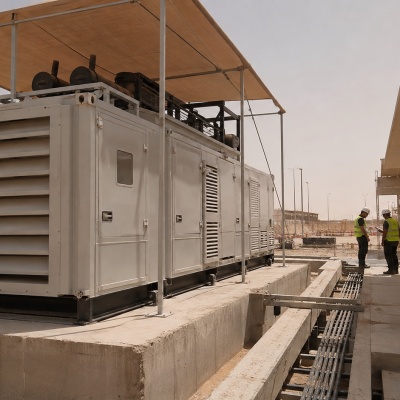
The installation area regularly experiences high summer temperatures, airborne sand and strong solar gain. These conditions can reduce generator output and obstruct airflow if they are not included in the original design. The project therefore treated cooling, filtration, acoustic performance and maintainability as core sizing inputs.
Customer requirements
- Automatic restoration of the critical bus after a utility failure.
- A redundant arrangement that allows one unit to be serviced without removing all emergency capacity.
- Stable response when the fire pump or another large motor starts.
- Outdoor equipment suitable for high ambient temperature, dust and intense sun.
- Local manual control plus remote operating status and alarm visibility.
- Fuel autonomy agreed from the client’s emergency plan and refuelling logistics.
Proposed generator solution
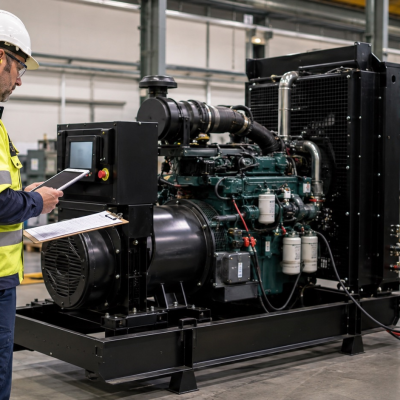
The concept used two 1,000 kVA-class silent diesel generator sets connected to an automatic synchronising panel. Each unit was to be site-rated from the chosen engine and alternator curves, with the defined critical bus kept within the available output of one unit after derating. The second set provides N+1 support for critical loads and can join the bus when a large load step or extended operation requires additional capacity.
| Design area | Recommended configuration | Purpose |
| Electrical output | Project voltage and 60 Hz confirmed before production | Avoids assumptions about the site’s actual distribution system |
| Cooling | High-ambient radiator and verified airflow path | Maintains temperature margin without relying on a nominal standard radiator |
| Dust protection | Heavy-duty air filtration and easy-to-clean intake screens | Controls restriction while keeping routine service practical |
| Controls | Automatic mains failure, synchronising, load sharing and load shedding | Restores critical power and protects the bus during large transients |
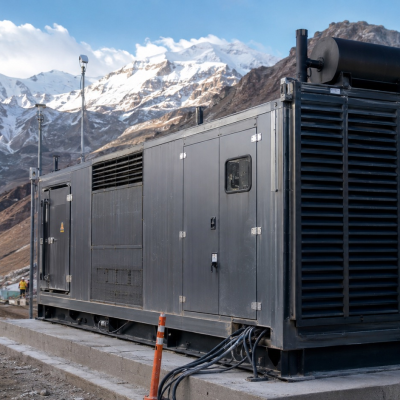
| Enclosure | Sound-attenuated outdoor canopy with solar-load consideration | Balances noise expectations with adequate cooling airflow |
| Fuel system | Bund or base tank, level monitoring and refuelling connection | Supports planned autonomy and safer operating checks |
| Monitoring | Remote status, alarms, running hours and key temperatures | Helps the facility team act before a warning becomes downtime |
Why hot-climate design changes the quotation
A standard generator rating is usually tied to defined reference conditions. If the required site temperature is higher, the radiator, fan power, air path and available engine output may all change. A restrictive silent canopy can make the cooling duty harder. For this reason, a quoted generator should state the ambient temperature, altitude, duty rating and site output on which the offer is based.
Sand protection also involves a trade-off. Very fine filtration or weather louvers can increase airflow resistance. The intake and radiator system must therefore be evaluated together, with accessible cleaning points and restriction monitoring where appropriate. Simply adding more filter media does not guarantee a reliable hot-climate package.
Fire-pump and process-load response
The fire-pump motor was treated as a separate transient case. Running kW alone is not enough: the starting method, locked-rotor current, permitted voltage dip and start sequence determine the generator response. The controls can block selected non-essential loads while the pump accelerates, then restore them after voltage and frequency stabilise. This can be more economical than choosing a much larger generator solely from arithmetic load addition.
Factory acceptance and commissioning
The proposed acceptance plan includes alarm and shutdown verification, automatic mains-failure logic, synchronising, load sharing, load shedding, full-load temperature observation and agreed step-load tests. Site commissioning should additionally verify cable phase sequence, neutral and earthing arrangement, ventilation clearances, exhaust back pressure, fuel transfer, emergency stops and remote communications.
Project outcome
The two-set architecture gives the facility a practical way to protect essential operations while retaining service flexibility. Site-rated cooling and filtration reduce uncertainty in the desert environment, and the control sequence makes the fire-pump event an engineered operating case rather than an emergency improvisation. The broader lesson is simple: a Middle East generator package should be specified for the actual summer site, not selected from a standard-condition headline rating.
Preparing a hot-climate generator enquiry
Provide the project city, maximum ambient temperature, altitude, voltage, frequency, critical and non-critical load lists, largest motor data, required autonomy, noise target and duty profile. Everyseek can then prepare a technical proposal that separates nameplate rating from guaranteed site output.
Publication check
Before presenting this as a completed customer project, replace the scenario details with verified order records and obtain permission for any customer-identifying information. Replace the AI-generated image with approved project photography whenever the post is used as evidence of delivery.
- Confirm the actual country, city, project type and customer-approved description.
- Verify frequency, voltage, ambient-temperature design point, quantity and site-rated output.
- Replace all proposed options with the signed bill of materials and approved drawings.
- Publish FAT values, noise data, autonomy and commissioning outcomes only when supported by records.